Showing posts with label NASA. Show all posts

Wednesday, May 18, 2016

What's in a Name?

If SLS could talk, this is what it would say...probably.
Photo credit: NASA (with my snark added)
In 'Romeo and Juliet', Shakespeare penned: "What's in a name? That which we call a rose by any other name would smell as sweet." One could take away from this that a name doesn't fundamentally change the nature of something.

Factually, that may be true...but in practice, we humans are a funny bunch. We grow attached to things and imagine them with personalities. Consider the robotic explorers we send out into the solar system: We cheer when they overcome hardware failures. We weep when they've made their last call to their handlers. We feel pain when they take their final plunge into a planet's atmosphere. We grow attached to these pieces of metal, and mourn their passing, just as if they are living, breathing things...not soulless contraptions built by man.

Names might not impact function, but they matter to us. Would we space nerds have been so attached to something called 'OV-104'? No...no we wouldn't. However, saying 'Atlantis' evokes mental images that any space enthusiast will immediately see in their mind's eye. Same goes for the the words 'Mercury'...and 'Gemini'...and 'Apollo'. Those names convey a special feeling for the programs they represented. Not only that, but the individual spacecraft were christened with meaningful...or, sometimes, playful...names which gave one a sense of personality of the inanimate object carrying our intrepid explorers across the vastness of space.

Certainly, hearing: "Houston...Tranquility Base here...LM-5 has landed." doesn't carry the same impact. It just doesn't.

So, you may be asking, "Curt - what's your point?". My point is that America's next great rocket - the launcher ostensibly meant to carry crew and machines out of low Earth orbit for the first time since the days of the Apollo program - has been stuck with a horrible, clinical-sounding name: the Space Launch System (or 'SLS' for short). Though I love the rocket, I *hate* the name. Heck, even the cancelled predecessor to SLS had a cool-ish name: Constellation.

And while the space shuttle was technically the 'Space Transportation System' (STS), at least the individual orbiters were given meaningful - and memorable - names. While our nation's spacefaring endeavors might only be a few decades old, surely we haven't run out of 'cool' names for our rockets. Come on - this is America...WE LANDED PEOPLE ON THE MOON!!!! We can do better than calling it 'SLS'.

NASA: Names matter. Make it happen.

Saturday, February 13, 2016

A Song of Ice and Firing Stands

Ice cares not if you have AWD, Mr. Subaru.
I love Huntsville, Alabama. Really, I do. In fact, it's one of my favorite places to visit, and were it not for me being so far along in my career, I'd likely be looking to call 'Rocket City' home. However, the city that helped build America's manned space program hides a sinister secret - a "monster" who looks to snatch unsuspecting motorists from the apparent safety of the elevated arterial roadway and hurl them willy-nilly into the concrete barriers separating travel lanes from the near interminable drop to the ground below.

I know this monster. I've met this monster. I've *survived* this monster. On my birthday, of all days, this beast chose to rear its ugly head and attempted to add me to its collection of broken and charred victims. But not this day. My trusty steed - the venerable Forester - quickly leapt into action, deftly dodging left...then right...as we were locked in an epic battle with Huntsville's silent killer: snowy roads.

OK, perhaps it wasn't quite so dramatic...but I *did* do a bit of dodging to the left and right...mostly because I started sliding on the ice and was doing all I could to keep from hitting the wall, or the other cars sharing the road with me. I don't care how good a driver you are, or what kind of car you drive, ice is the great equalizer. With the 'pucker factor' having risen to dangerous levels after my brief, but near-catastrophic, encounter with the icy roads, I decided to get the heck off the 'skyway' and move down to the surface streets, which I hoped would be clearer.

I liked the framing of this shot. That's it.
So, what dragged me out of a safe and warm hotel room in a city nearly four hours from home? NASA was hosting a Social event at many of their Centers across the country to mark the 2016 'State of NASA' address by Administrator Bolden. Marshall Space Flight Center (MSFC) in Huntsville was one of those sites, and had invited nearly twenty social media participants to visit the Center.

I know that I've visited MSFC many times - often writing about the trip here in my blog - and I almost feel like it's "my" Center. In fact, I had been to Marshall a scant two months prior to report on the near-completion of the stand meant to stress-test SLS's massive liquid hydrogen tank. Nevertheless, my passion and interest in our nation's space program is such that I could likely visit the Center weekly and not tire of it, or feel jaded about the major role Marshall has played - and continues to play - in America's space flight heritage.

Being the Center responsible for designing, testing, and validating SLS, one would expect any Social event at MSFC to focus heavily on that vehicle...and this day was no exception. Marshall's newly-appointed Center Director - Todd May - greeted the group, welcoming us to the Center and gave us a brief overview of Marshall's activities over the past year, and then took a moment to answer questions.

Marshall Space Flight Center Director Todd May
With the possibility Congress could direct NASA to launch the proposed 'Europa Clipper' mission on SLS, I asked May if the Michoud Assembly Facility (MAF) - which operates under Marshall's "umbrella" - could accommodate that need along with the tentative flight date of EM-2. According to May, though the nominal production rate for SLS will support a cadence of one flight per year, capacity at MAF will allow for a surge rate of two SLS launches per year, and a 'spike' capacity of three per year. Any cadence higher than that, or a sustained rate of two-plus vehicles per year, would require expansion at MAF.

After a few more questions, the group heard from two engineers working on the SLS program - Michelle Tillotson and Nick Case - before heading to the avionics area. There, engineers and programmers are 'tweaking' SLS's flight computers, followed by simulated launches, to gather data about how the rocket will perform throughout nominal - and off-nominal - flight profiles. Even a shortened simulated launch can generate several terabytes of data for the engineers to examine. As various components of SLS move from design to testing to qualification stages, that real-world performance data is integrated into the testing regime. In fact, shortly after the successful test of the new 5-segment booster in March 2015, Orbital ATK had delivered the raw data to the SLS engineers in Huntsville.

Yes, I took a selfie at a rocket test stand. Not ashamed.
Departing the avionics area, the group boarded the bus to travel to the test stand area at Marshall. This part of the Center has a rich history - here, von Braun and his team tested many of the rockets which would carry America's astronauts to Earth orbit...and beyond. Situated between the two SLS test stands currently under construction is the massive firing stand used to test the mighty Saturn V rocket. It's hard to imagine the sound which must've roared through the Tennessee River Valley when those engines were tested.

Though quiet this day, the stand nonetheless presented an imposing sight: its massive concrete and steel structure stood as a testament to the power it was built to restrain. With snow continuing to fall in fits and spurts, and a healthy wind chill to boot, the group was invited to take an elevator ride midway up the structure to get a view of the two SLS stands being built nearby. Once complete, those stands will push, pull, and twist the core stage's liquid hydrogen and liquid oxygen propellant tanks, stressing them to flight limits, and beyond, to ensure SLS will be the safest vehicle to launch crew and cargo.

Les Johnson - Dep Mgr, NASA's Advanced Concepts,
compares the thickness of the sail to one's hair (or lack thereof).
Thoroughly chilled to the bone, we dutifully boarded the bus to head to the 'flat floor' facility to meet with some engineers working on secondary payloads which will fly on SLS. One of the more interesting payloads is a solar sail. This 86 square-meter sail is made out of a material the thickness of a human hair - 2.5 microns. The 'pressure' of sunlight will push on this material, accelerating the sail at a slow, but steady, pace without requiring fuel or engine. Smaller sails have been tested previously, but SLS will give these smaller secondary payloads the unprecedented opportunity to go beyond their usual "playground" of low-Earth orbit (LEO) and operate in cislunar space. Without the drag of Earth's atmosphere, thin though it may be in LEO, the sail should be able to accelerate slightly more rapidly (though 'rapid' is definitely a relative term when one is talking about the pressure of sunlight), providing more meaningful data to scientists.

Our final stop of the day was back at the US Space and Rocket Center. There, the group was given a tour of the new International Space Station (ISS) exhibit, which includes a scaled-down version of the real-life Payload Operations Center (POC) at Marshall, along with a "high fidelity" replica of many of the ISS modules. Save for the lack of cables, computers, and various clutter one many expect to find on an operational space station, the ISS mock-up is an accurate analogue to the real deal.

This is on the ISS. Really.
One of the more amusing stories came from 'Paycom Penny' (Penny Pettigrew). The astronauts on-station can speak with the ground operations not only through the expected ISS-ground radio communications, but also through more traditional means - a.k.a., a phone call. Pettigrew recounted an instance when she was heading home from a shift at the POC only to have her cellphone ring as she was on the highway. CallerID doesn't identify it as 'Space Calling' (though how awesome would *that* be?!?), so she wasn't necessarily expecting there to be an ISS-based astronaut on the other end of the call. Penny said when an astronaut calls, you'd better believe that's a situation when one pulls over to the side of the road to give the caller one's undivided attention.

Knowing that I had to take the long route back home in order to avoid the snowy conditions through the mountains, I excused myself from the last, optional bit of the day and headed home. As always, the Social was thoroughly enjoyable, and it's always nice to meet fellow space enthusiasts.

I would like to thank the people at Marshall, and at the Space and Rocket Center, for inviting the group out to take part in this NASA Social event. It's incredible to consider that a "normal person" like me has the opportunity to participate in something like this.

Saturday, August 15, 2015

Mars is just a little bit closer now...

What follows is a tale told by an idiot, full of sound and fury, signifying...well...quite a lot, actually.

On a hot August day in coastal Mississippi, NASA and Aerojet Rocketdyne tested an engine which will help power America's next great rocket - the Space Launch System (SLS) - to destinations beyond low Earth orbit...something that no crewed vehicle has accomplished in more than 40 years. But first, a bit of exposition is in-order.

After the retirement of the Space Shuttle in 2011, and the cancellation of the nascent Constellation program shortly after that, many considered NASA to be 'dead'. In fact, I've spoken with several people who ardently believe that NASA was shut-down after the Shuttle program ended. Nothing could be further from the truth.

While it is true that no crewed launches have occurred from US soil since the Shuttle was 'put to pasture' (which is a shame...and perhaps a topic for a later blog entry), lack of manned flights does not equate to NASA being a moribund agency. The dynamics of spaceflight have changed in a relatively short time. No longer are rockets the domain of deep-pocketed governments - private companies are now competing to take cargo and crew to low Earth orbit and the Internal Space Station (ISS) is now host to many non-governmental experiments.

Where does that leave NASA if not to launch astronauts to the ISS? Exploration, that's where...and that's the purpose of SLS - to be an exploration-class vehicle to take humans back to deep space, and to destinations which were the domain of fanciful dreams just a few generations ago. In order to do that, hardware must be tested...and re-tested...and tested again. That testing and validation were the driving forces behind Thursday's test.

Complete RS-25 assembly.
Photo courtesy Aerojet Rocketdyne.
Not your grandfather's rocket engine
Though the RS-25 engine is essentially the same as the Space Shuttle Main Engine (SSME), there are some significant differences, key of which is the engine's "brain" - the controller. Many years have passed since the initial design of the SSME...and while it may have received an occasional update over the life the Shuttle, SLS required something a bit...'smarter'.

Aerojet Rocketdyne had been testing a modernized variant of the Saturn-era J-2 engine (the J-2X), which was to be used in the now-canceled Constellation program...and was in contention to be used as the upper-stage engine for SLS. Though down-selected in favor of the RL10, the modern controller from the J-2X could be modified to work on the RS-25.

Beyond testing the new controller, the engine will also be running at higher thrust levels than it did during the Shuttle's tenure...and the cryogenic propellants will reach the engine at a colder temperature and higher pressure. Though fully capable of pushing more power than it did on a Shuttle flight, engineers desired to not do so as the engine would be subject to greater 'wear and tear'...and since it was meant to be a reusable engine, that additional stress would result in higher costs.

However, since SLS isn't going to be reusable (other than, perhaps, the Orion crew capsule), engineers are comfortable pushing the engine harder, with each of the four engines producing approximately 550,000 pounds of thrust.

RS-25 in testing conditions on the stand.
Photo courtesy Aerojet Rocketdyne.
These go all the way to '111'
With the engines now projected to deliver 111% of the original design's thrust, a mighty roar was sure to be heard across the bayou of southern Mississippi. To quote a good friend: "Any day that NASA gives you ear plugs is pretty much guaranteed to be a good day."

This was to be my second static engine test, the first of which was for the upgraded Solid Rocket Booster (SRB) in Utah earlier this year. At that event, we were warned to not look directly at the exhaust plume. Thinking that the 2.5 kilometers between us and the booster should be sufficient to attenuate the blinding brightness, I chose to look at the exhaust. Ouch - the light...IT BURNS! I think I had spots on my vision for the next hour or so.

So, since NASA had seen fit to provide us with earplugs, I was not going to question the need for hearing protection - the plugs were inserted as soon as ignition time neared. Though I heard no countdown, certain visual clues indicated the time was near...well, that and the clock inched towards 4:00 PM, which was when the test was supposed to occur.

I guess you just had to be there
Through the cushioned protection of the earplugs, the engine roared to life with a mighty 'WHOOSH!' followed by a loud, sustained crackle and roar and cloud of steam. Nothing I've ever done in life could've prepared me for the visceral experience this engine test would be. Even the SRB test in Utah paled in comparison to the symphony of sight, sound, and feeling from the RS-25. While the SRB was a distant 2.5 kilometers away (about 8,200 feet), the RS-25 would be a scant 1,200 feet away.

While my expectations for sight and sound from the event were easily surpassed, I was wholly unprepared for the FEELING of the engine. Every crackle and thump from the engine was accompanied by a tangible pressure wave. I could feel it in my chest...I actually *saw* shirts flutter in concert to the waves...and this was only one engine! Imagine the cacophony which will accompany the four engines from core stage's full-burn test in two year's time.

I don't know if you watched the event live, or if you have since seen replays like the one below, but there is nothing - NOTHING - that can compare to the experience of being there. I am truly sorry that I lack the skill to convey the wash of emotions and feelings that I felt with this test. Yes, it was that impressive.


What's next?
NASA and Aerojet Rocketdyne will analyze the data from the test, and perform a few more tests and should wrap-up design validation before the end of this year. After that, the next big event will be the core stage 'green fire, which will be all four flight engines firing at once - something that hasn't happened at Stennis Space Center since the days of Apollo.

SLS is a big deal. It's big for NASA...it's big for America...and, yes, it's big for humanity. The successful test brings us one step closer to the moon, to Mars, and beyond. I don't know about you, but I'm excited. The rumors of NASA's death have been greatly exaggerated. Not only that, but I think the agency's most incredible accomplishments may still be ahead of us. 

Tuesday, July 7, 2015

Why Should You Apply for a NASA Social?

Part of the group from the QM-1 NASA Social
One of my first blog entries, waaaaay back in 2014, was meant to be an encouragement to those that may be thinking of applying for a NASA Social event, but - for whatever reason - were reluctant to do so. Now that I'm a 'grizzled veteran' of four NASA gatherings, I thought I would revisit the topic and share some of my insights and observations.

Prior to applying for my first NASA Social, I would frequently see tweets from many of the 'space people' I follow on Twitter discussing some super-cool NASA project, often with the #NASASocial hashtag. As I had not heard the term 'NASA Social' before, I assumed that it was an event catering to industry insiders and space journalists. Considering the 'behind-the-scenes' access that was being displayed via that simple hashtag, I thought it a reasonable assumption.  

Sidenote: you *are* following NASA on one of its many active social media accounts, right? If not, head over to the NASA social media page for links to all the 'social media goodness'. 

After a bit of research, I realized that the NASA Social wasn't intended for industry insiders; no - it was meant for the average, everyday, space enthusiast with a passion to share their experience with the world. It took but a second for me to realize: "Hey - I can do that!" I have loved the space program for as long as I can remember, and the realization that I could be a "part" of it, regardless of how minute that involvement might be, was one of the absolute coolest things I had ever considered.

Then self-doubt crept in: "Why would NASA want me there? I'm just a network engineer in a school system. I don't have nearly the amount of social media followers these other people seem to have. There's no point in even applying...I won't get picked." So I didn't apply. I would continue to see numerous tweets about events NASA was holding...events in which I had a keen interest...but I felt I had nothing special to contribute. So I wouldn't apply.

Finally, and I have no idea what sparked the initiative for me to do so, I applied for an event - the unveiling of the #WeldingWonder (or, more appropriately, the 'Vertical Assembly Center'...but, if we're being honest, #WeldingWonder does sound a bit more...awesome..right?). I reasoned that it didn't seem as "impressive" as other events (launches, rover landings, etc.), so there was a high likelihood that I might be selected. Additionally, being the engineer that I am, I was extremely interested to see this aspect of building America's next great rocket.

Though initially waitlisted, I was eventually extended the invitation to visit NASA's Michoud Assembly Facility and Stennis Space Center for an incredible tour of the facilities that are critical to building SLS. I met many great people - some of which I now proudly call friend, shook hands with NASA Administrator Charles Bolden, and had one of the most memorable experiences in my life. Seriously.

You might say: "But Curt - I'm not an engineer. I'm just a travel blogger...or fashion writer...or nature photographer...or...insert whichever non-space vocation you want to here...why would NASA want me there?" Because there is already a bevy of space-centric journalists and industry bloggers out there that are reaching the same types of people. However, if you have an interest in space - and enjoy sharing that interest with others - then you're EXACTLY the sort of person NASA would love to have at one of their events.

So, please...if you're 'on the fence'...trying to decide whether or not to apply for one of the upcoming NASA Socials...don't let that voice of self-doubt prevent you from applying for an incredible life experience. To quote hockey great Wayne Gretzky: “You miss 100% of the shots you don’t take.”

Thursday, April 30, 2015

Things I think I think...I think.

I know it's been a little while since I've posted anything - darn that writer's block! Of course, I just write for fun...and it's been busy at work lately...so you get what you get. I know I generally write about space-related topics, with an occasional tech tidbit thrown in...and this post will continue the trend, with some other items sprinkled-in. I welcome your input and would love to have a reasoned discussion on any/all of the items below.

Soyuz Progress M-27M Failure
Short response: I hate that the ISS won't receive this shipment of cargo and supplies. I know the astronauts aren't in dire need of supplies, but it's not as if everything that was sent was superfluous. I also hate that we have to rely on the Russians for anything. SpaceX's first successful crewed flight to the ISS can't come soon enough, and I hope OrbitalATK is able to quickly recover from the Antares failure. Couple that with ULA's reliable Atlas V and Boeing's forthcoming CST-100, and I hope we never need a scrap of anything launched from 'Mother Russia' ever again.

Long response: Probably best if I just stick with the short response.

Apple Watch
I briefly covered my preliminary thoughts about the Apple Watch in a prior blog post, but now that it's been released, have a changed my mind? No. Well...probably not. Ok...maybe. Crap. I don't know. I'm generally an early adopter, so that drives me towards wanting one. But the smugness that seems to emanate from Apple (more so than usual) over the thing makes me want to throw up in my mouth. Also, I'm still not quite sure how I'd use it. I might rather save my money for something else...maybe a GoPro. Or a new kayak. Or a replacement DSLR for my aging D50. All I know is that it's not taking a whole bunch of willpower to refrain from ordering an Apple Watch...and that might be telling me all I need to know about it.

NASA's EM Drive
Have you seen the news? NASA has designed an "impossible engine" that will open up the stars to humanity! Or so the stories would have you believe. While I'm not an engineer, I'm highly skeptical that this is what people think it is. I don't know why...but I don't believe it. I *want* to believe it...and I sincerely hope that it IS a game-changing method of propulsion...but something in my gut doesn't feel right. Well, it's either that or the refried beans I had with dinner...but I'm sticking with 'skeptical'. Hopefully we'll hear more about it soon - I'm interested to see what others, beyond a small group of "insiders", think about this.

iPhone 6 Plus
I had been using a Samsung Galaxy S4 as my work phone for a year (or so) and often complained about the unwieldy size of the phone and its cumbersome use one-handed. Once the iPhone 6 and 6 Plus were released, I purchased an iPhone 6 to replace my iPhone 5 (which was handed down to my daughter) because I thought the 6 Plus would be too big and suffer from the same issues as the Galaxy S4. Fast forward a couple months and I upgraded my work phone to an iPhone 6 Plus (thanks, Dr. Stringbean!)...and I love it. Absolutely love it. I'll admit to being a bit of an Apple fan, but I'm a tech geek, in general. I wanted to like Android...but I never felt "at home" with it. Now that I'm back on iOS on my work phone, I've found my workflow is much smoother - contacting the technicians at the sites is more seamless...sharing files to other users is foolproof...and it's a more polished experience. Couple that with the exceptional display, which isn't nearly as bulky as it might appear, and the iPhone 6 Plus is a great phone. I wish I'd gotten one sooner.

Blue Origin's Test Flight
I don't know about you, but this seemed to come out of nowhere. I had heard nothing of an upcoming test, nor did I really take much stock of Blue Origin. I made the mistake once before not believing in an internet billionaire, and now I've done it again. I guess I really need to alter my perception of the capabilities of these "new space" companies and how quickly they might be relevant. I'm a huge fan of NASA and of a national space program...but maybe it's not so far-fetched to think that private space entities will soon surpass our national endeavors. I'll have to keep my eye on them...and, perhaps, not immediately dismiss the next Musk or Bezos that comes along. These are exciting times.

Our Lady of Perpetual Beta - a.k.a., 'Google'
We're testing some software that allows us to integrate Google's Cloud Print capability into our district's Active Directory infrastructure. It works far better than I expected save for one thing - a user must accept a shared printer via a full desktop browser before the Cloud Print capability will work on a mobile device. Really? That's not terribly convenient, Google. I know 'Google Cloud Print' is still in beta, but that's a pretty big stumbling block. Please fix it.


OK - that's all for tonight. I'm sure there's a bunch more I could have discussed that would bore you to tears, but I'll leave it at that. If there's something that piqued your interest or raised your ire, please leave a comment - I love a good discussion. Until next time, thanks for reading.

Saturday, March 21, 2015

Let's light this candle! Part 3

The QM-1 NASA Social group and Astronaut Stan Love.
The day began just as early as had the previous one, yet was very different - we were going to see the world's largest Solid Rocket Booster (SRB) test-fired. Though the people at Orbital ATK (OATK) had cautioned us that many people - space enthusiasts, locals, etc. - would likely make their way out to the public viewing area, I don't believe many of us in the Social group understood what that meant, or gave a lot of weight to it...but we would soon be shown that they knew what they were talking about.

What had been a dark and nearly solitary drive to the OATK facilities the previous day turned into a steady stream of vehicles forming a nearly unbroken line for many miles. While it was a bit heartwarming to know that interest in various aspects of the space program was still strong, I must admit that I was a bit concerned whether or not there'd be room for everyone.

People...lots and lots of people.
Luckily, the throng of vehicles was moving at a steady pace...and a great majority of them weren't going to the private OATK/NASA Social area...so all was well, right? Wrong. Oh, so very wrong. I haven't played musical chairs since I was a kid, but the frantic 'dance' to get a parking spot was a pretty close approximation to what happens in the mad scramble to grab a seat once the music stops. As the valid, lined spots filled, many people decided to settle for any available spot of asphalt. I was grateful that I successfully fought against the urge to hit the snooze button to get some more sleep - a delay of a few minutes might've meant the difference between getting a space or not.

Upon snagging one of the rapidly disappearing parking spots, I gathered my stuff and headed inside to the lobby. While waiting until time to board the bus, I took a moment to take a look around at the people that were milling about packed elbow-to-elbow: these weren't just some poor schlubs like myself...in the crowd were high-ranking military officials, industry big-wigs, and even a few astronauts! Although, in my mind, I *knew* the QM-1 event was a big deal, I'm not sure I quite realized how big of a deal it was until I saw these VIPs all in the same room. With me. Cool.

Colorful sunrise seen prior to heading to private
viewing area.
After a while, the room began to empty as people boarded the waiting buses that would take us to the private viewing area. We had a couple of stragglers still inside the building, but that gave us the opportunity to see a gorgeous sunrise from the windows of the bus. After the short delay, the bus departed and delivered us to the spot from where we would see the test-fire. Several members of the group, including me, headed to the viewing area as soon as we stepped off the bus so we could take some pictures of the booster, which was 1.25 miles (approx. 2.01 kilometers) away. Seeing how far away it was, there was a small concern that the event might not be as impressive as I thought. We'll revisit that concern in a bit. While I was examining the viewing area, one of our fellow NASA Social people came out to our group to say that there was a speaker in the NASA Social trailer waiting to talk to us.

One of these guys is cool, funny, super-smart,
and an astronaut. The other is me.
The NASA Social organizers had arranged for Astronaut Stan Love to speak with our group. While I have had the pleasure of listening to astronauts speak prior to this, I must say that Astronaut Love is - hands down - one of the most energetic, enthusiastic, engaging, entertaining, and interesting speakers I've yet to encounter. I hope that NASA and the Astronaut Office knows what a resource they have in Astronaut Love...I think he's an excellent representative of the organization and could help generate a lot of interest and excitement in crewed space flight.

Love was peppered with questions, running the gamut from history...to geo-political...to deep science...and even aliens. He performed deftly, and was quite candid in some of his responses...something for which I was immensely appreciative. Some of my favorite exchanges/responses (mostly paraphrased):

  • Love: On my mission, I didn't exercise. I thought it wasn't really necessary for the short amount of time I was in space. However, upon returning to Earth, I'd lost 8 pounds of muscle from my legs. People, if you go to space, EXERCISE!
  • Attendee: What do you think about cooperation with what might be geo-political foes?
    Love: It's cheaper than fighting them.
  • <after discussing the enormous hurdle of life-support in deep space>
    Attendee: What do you think of Mars One?
    Love: <pause> I believe I have already answered that.
Love stayed with the group for much longer than had been arranged, even joining us on the trip up to the booster after the firing.

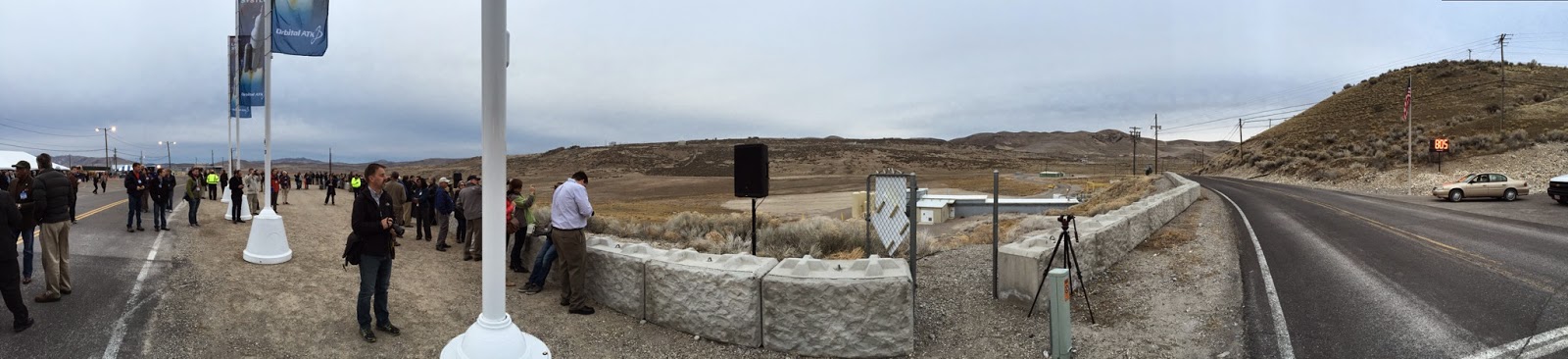
Pano of the 'Media' section of the viewing area. SRB is down the road.
With the Q&A session now over, it was time to move to the viewing area for the static fire test. The test had a multi-hour window in which to occur (permission is granted based on weather conditions - no one wants the exhaust/debris cloud to pass over populated areas) and was running a few minutes behind. We took the opportunity to chat with each other, and talk with those around us. One of our group, a high school teacher, took the time to set up a Skype call with her class as the clock ticked-down to the firing. Very cool, and I love her dedication - I would've loved to have had a teacher like that in high school.

As the clocked neared -01:00, I prepared my cameras - both my always-with-me iPhone and my old-but-trusty Nikon D50. The announcer counted down, and when he reached T-10 seconds, I began recording:


Just as thunder follows lightning, it took several seconds for the booster's roar to reach us (in the video, you can hear the announcer call "Plus five" just before you hear the booster). What followed was an impressive display of sight and sound. The booster's flame was so bright that looking at it for more than a short period of time wasn't recommended...and the sound of the booster was every bit as impressive as I thought it would be, counter to my earlier concerns. The burn lasted for slightly more than two minutes, right in-line with expectations.

After retiring to the trailer for lunch, the group was taken to the test area for some pictures and to be able to see the SRB from a much closer position. Stepping off the bus, the smell of spent rocket fuel was strong...but non unpleasant. OATK workers were busy securing the area, and we were restricted from approaching too closely, but there was no problem finding a good place from which to take pictures. Even though the test had occurred nearly two hours earlier, the area was still quite warm from the flames, and the aft portion of the booster was being sprayed with water to accelerate cooling. Fun fact: The deep layer of sand over the concrete structure below the booster is turned to glass from the intense heat of the flame.

All-too-quickly, we were rounded up and told to get back on the bus...thus drawing to a close the QM-1 NASA Social. I can't speak for others, but I had an exceptional time. Both NASA and Orbital ATK did an outstanding job of arranging an informative and entertaining event, and it's something I will remember for the rest of my life. I enjoyed reacquainting myself with some NASA Social alum from previous events, and loved meeting new and interesting people from this one.

I hope that you have learned something about NASA and/or the space program that you didn't know, and I appreciate the time you've taken to read this. I took a ton of pictures of the entire trip, and have shared them in a Flickr album as there was no practical way to include them in the blog entries - feel free to take a look. Until next time, thanks for reading.
Thanks for reading!

Thursday, March 19, 2015

Let's light this candle! Part 2

I need one of these. For reasons.
Welcome to 'Part 2' of my experience at the incredible NASA Social for the QM-1 Solid Rocket Booster (SRB) test. If you've not yet read 'Part 1', I would like to invite you to do so before reading this entry. As before, I'd like to thank NASA, the NASA Social team, and Orbital ATK (OATK) for organizing this event, and extending the invitation to so many of us space enthusiasts to witness such an incredible experience as we lay the groundwork for humanity's steps to become a multi-planet species.

As a reminder, security guidelines prohibited recording/photographing anything once inside the security perimeter, so there is a lack of pictures from many of the interesting places we visited...and because I didn't think ahead, neither pen nor paper was in my repertoire...so I'm digging through the recesses of my less-than-perfect memory for much of the information from 'Day 1'. If I happen to miss a detail or two, feel free to mercilessly mock me...or politely correct me - I'm simply pleased you're reading this.

After passing through the gate, we only had a short journey to our first stop. We had to break into two smaller groups to make the tour through the areas more manageable. At our first stop, an OATK engineer gave a brief, but informative, description of one of the omniaxial gimbal bearings being developed for a future SRB (though the one on SLS is very similar). The bearing consists of multiple, alternating layers of a rubber compound and aluminum (I think), which allows hydraulic actuators to move (gimbal) the SRB's nozzle +/- 8 degrees to maintain a proper thrust angle. If your eyes glazed over after reading that, the short of it is this allows the rocket to steer a bit to make sure it's heading in the correct direction.


"Ares I-X launch 08" by NASA
Sandra Joseph and Kevin O'Connell
The group was then ushered into the area where the liner/insulation is applied to the interior of the casing and nozzle. The insulation was the primary culprit in delaying qualification of the new five-segment booster. Though the new SRB was essentially the same as the Space Shuttle's four-segment booster, and practically identical to the five-segment booster used in the Ares I-X test flight several years earlier, NASA was no longer given special allowance to use an asbestos-based insulation as they had been for Shuttle. This meant that booster engineers needed to find a solution that didn't add undue weight while still maintaining the thermal protection characteristics as the now-banned insulation. Unfortunately, there was a reaction between early iterations of the insulation, and the fuel in its liquid-ish state, which created voids/pockets as it cured. These voids were a serious issue and could have promoted a casing/joint burn-through, greatly increasing the likelihood of loss-of-vehicle. It is believed that the insulation problem has been resolved, which has allowed NASA and OATK to proceed with qualification testing.


Our group in front of one of the mixers.
Credit: Orbital ATK
We were also allowed the opportunity to enter one of the propellant mixing facilities. In these hardened buildings, the ingredients are placed into a temperature-regulated 600 gallon "bucket" and mixed until proper consistency is reached. Truly, the machine looks like a super-industrial version of a restaurant floor mixer...albeit with a much more dangerous batch of "cookie dough" to blend. The mixer blades are quite large, and tolerances are tight - while blades scraping on the inside of a metal mixing bowl might be OK when making cookies, stray sparks and unnecessary heat and friction are things to be avoided when blending solid propellant. Due to the high degree of safety required when mixing the propellant, the building is unoccupied during operations and everything is controlled from a remote location. The remote operations center keeps a watchful eye on everything via cameras and sensors. This level of precaution is not unwarranted - in June of 1985, one of these hardened buildings was destroyed while mixing propellant, resulting in the loss of the $3 million facility.

Unlike liquid-fueled engines which have their fuel pumped to them when needed, SRBs need to have the fuel 'cast' into a casing. This casting occurs in a VERY large building, with deep pits designed to hold the huge motor segments while the putty-like fuel is poured/dropped/fed into casings. Since SRBs cannot be actively throttled, varying levels of thrust can be passively achieved by casting the fuel in a particular shape. Since the fuel burns from the inside of the casing outward, the fuel's surface area will change over the duration of the burn...and a change in surface area will directly impact the amount of thrust being generated. This casting is achieved by placing a mold into the segment casing while the fuel is being poured, which creates the desired shape. The three middle segments use the same mold, but the forward and aft segments require molds specifically designed for them.


Other than the actual booster test, I sorely
wanted a picture of the X-Ray facility.
One of the more interesting things, other than the huge X-Ray building we could not enter, was the tour of the SRB stress test area. In this facility, we were shown the results of what happened to the forward and aft sections of the SRB as they were stressed beyond their operational limits. At first glance, the damage didn't look too bad...but closer inspection clearly showed what would've been catastrophic failure in an actual flight. However, this damage only resulted from applying significantly more force to the attachment point than would be experienced during a real launch. It's important to test items not only to their design specification, but to see how far beyond that they can go before failure. In so doing, NASA is helping to design and build the safest human-rated heavy launcher yet.

We ended our day by taking part in a NASA-televised conference featuring many of the key people involved in developing not only the new boosters, but the SLS program as a whole. I've seen Todd May (NASA SLS Program Manager) speak at a couple different events, and I quite like him. It's obvious he's very intelligent, but has an easy manner to his speech that renders him immediately likeable. I've also had the pleasure of hearing Bill Gerstenmaier (NASA Associate Administrator Human Exploration and Operations) speak once before. Though there was not a lot of new information gleaned from the assembled team, it was still an excellent experience and helped set the stage for the next day's static firing.

And on that note, I'll end 'Part 2'. If you're interested in watching a short video about much of what our group saw, please take a look at the NASA Marshall-produced video below. Thank you again for reading, and I hope to have 'Part 3' up soon.


Tuesday, March 17, 2015

Let's light this candle! Part 1

Pano of the QM-1 Solid Rocket Booster, post-firing.
Through the graciousness of NASA, the NASA Social team, and Orbital ATK, I was invited to Utah to witness the first of two qualification firings of the solid rocket booster (SRB) slated to help launch NASA's Space Launch System (SLS) some time in 2018. This was my fourth(ish) NASA Social (you can read about two of my other experiences - Marshall Space Flight Center and SpaceX CRS-5 - on my blog), and I have met many wonderful people and had some incredible experiences. If you've ever considered applying for one, I cannot recommend it more highly.

I'd like to first apologize for the lack of photos from Day One of the two day event - security restrictions made taking pictures impossible once passing through the facility's security perimeter. In fact, we were instructed to leave all electronic devices on the bus, else we might inadvertently take a picture of something we weren't supposed to...and the NASA Social people would get in trouble. So...I had no method to take notes or disseminate information because I didn't think about bringing a pen and notepad. I'm obviously not an experienced reporter...or a reporter of any sort. So, if I get a fact or two (or all) wrong...or I miss something altogether...please accept my apologies and invitation to set the record straight.

Flying over the Grand Canyon helped salve
the pain of connecting through PHX.
My journey to this Social starts, as always, in Atlanta. Though historically a non-flyer until late 2013, I have recently become a relative regular at the mini city known as Hartsfield-Jackson International Airport (ATL). If you've never been to ATL, words often will not do it justice - it truly is a city unto itself: security, subway system, a multitude of dining options, etc. - and the people...holy moly, the people. It's the busiest airport IN THE WORLD! You might be thinking: "Why is he talking about the Atlanta airport in a blog entry about NASA testing a booster?" Well, that's because I have finally found an airport WORSE than ATL: Phoenix's Sky Harbor International (PHX). The terminals are far enough apart to make walking a chore, but too close to justify a train system like ATL. On top of that, even their new gates are inadequate to handle the number of people coming through. All-in-all, PHX was a terrible experience. If you can avoid connecting through there, I highly recommend it. For me, unfortunately, both my outbound and return journeys would go through PHX.

The road is at 5,500' elevation, and the mountains
are nearly 2,000' higher still.
Landing in Salt Lake City (SLC), I was greeted with an astounding sight - mountains taller than I'd ever seen. You see, I'm a Southern Boy...and though I live in the foothills of the Appalachians, there is nothing we have here in Georgia - NOTHING - that compares to the towering beauties in Utah. In fact, I believe Georgia's tallest mountain barely exceeds the altitude of the level of the valley floor of where I was staying in Logan, UT. I love mountains...LOVE THEM...and I was being treated to a visual spectacle. Utahns, you have a lovely state. However, as impressive as the sights were, the real treat would be the next couple days.

Tuesday started bright and early, with a 5:00 AM alarm to make sure I had time to get ready, eat breakfast (ever had a "spudnut"?), and drive the nearly 70 miles from my hotel to the Orbital ATK (OATK) facility in Promontory, UT, by 7:30 AM. (Sidenote: Does 'Promontory' sound familiar? It did to me, too...and once I made the trek out to OATK, I knew why: the site of the 'Golden Spike' - the joining of the East and West transcontinental rail lines - was there...and there is a National Historic Site devoted to it. Very cool.)


Some familiar faces...but many new ones!
Once the obligatory "pulling into the wrong place" item was checked-off my 'list', I immediately encountered someone I'd met at the Michoud/Stennis Social. Being a somewhat introverted person with slight social anxiety, it was nice to see a familiar face. We headed into the facility (after using the wrong entrance) to get checked-in, and there were even more fellow NASA Social alumni...though new faces far outnumbered the familiar ones. At the introduction, much later in the day, it was discovered that our group represented people from all walks of life and from a myriad of industries...among them: a school teacher, someone that works for Twitter, an illustrator that's worked on DC and Marvel projects, a representative from a non-profit in neighboring Idaho, and even someone that's worked (or is still working) for Bigelow Aerospace! A very diverse and exciting bunch.


Rocket display at the Orbital ATK entrance
Then came time for us to board our bus for the tour of the Orbital ATK facilities. We knew we were in for some pretty cool tours, filled with information and "behind-the-scenes" access...and OATK delivered. However, that'll be for the next part of the "Let's light this candle!" series. Check back in the next day or two for the continuation. Until then, thanks for reading and I hope you join me for Part 2.

Wednesday, December 24, 2014

Turning Disappointment Into Bliss - Part 1

Falcon 9 & Dragon - ready to head to the ISS...but not
today.
Many of you may know that I recently took a trip to Florida to cover SpaceX's CRS-5 launch to the International Space Station. Originally scheduled to fly on December 9, the launch was later delayed a week...then a few extra days to December 19. Through the generosity of 'The Universe' and Amy (@AstroGingerSnap on Twitter - you need to follow her. Really.), I applied for media credentials for the event...hoping to see my first in-person launch. NASA approved the request and I was to be issued my first-ever media credentials.

So, on Wednesday, December 17, I set-off from the northern Atlanta 'burbs for the 8-hour drive to Titusville, FL. With all of my requisite gear (camera, multiple smartphones, laptop, tablet...you know - the essentials) in-tow, I pondered what the sights and sounds of a launch might be like. Thinking happy thoughts, I wiled away the miles with nary a concern. Even the ubiquitous Florida toll roads didn't irritate me as much as usual. OK, maybe that last part is a stretch - those toll roads tend to make me a bit "stabby", and this trip was no different. I *hate* toll roads.

Anyway, as the final miles ticked off and I neared the hotel, the excitement grew within. This was getting real...very real. I was going to see a launch! Woo hoo!

A few minutes after checking-in and unloading my car, I received an ominous message from Amy that said (paraphrased): "Here's a link that I don't think you're going to like." 

::clicks link::

Uh oh. Unconfirmed reports indicated that the Falcon 9's static fire test didn't go as planned and the launch is being delayed until at least the 20th...but likely later. Much later. As in '2015-later'. Crap on a cracker. So, I'd driven 500+ miles for a launch that was now likely to not occur. On top of that, though NASA had invited a few dozen people to take part in their planned NASA Social agenda for the launch, the media types like myself had no such activities in which to participate. I contemplated checking out of the hotel and head home the next day.

Amy said that the briefing was still scheduled for Thursday morning, and that more information would be given then...but all signs pointed to a significant delay. I slept fitfully, dreaming of disappointment. Waking early the next morning, I set off for the badging office to sign-in and received my credentials. Though I knew there was to be no launch, my excitement level was still pretty high. At the very least, I would see the Vehicle Assembly Building (VAB) from close range, and that's pretty cool in-and-of itself.


Obligatory selfie w/ the VAB in the background.
Arriving far before the start of the briefing (remember, kids: "Early is 'on-time'...and on-time is 'late'."), I sat in my car for a moment to take-in the scenery...and the history. I was in space nerd heaven. The iconic VAB was just a stone's throw away...and the new clock, with Pad 39A as its backdrop, was nearby.

I strolled around outside, trying my best (but failing) to not look like a KSC-noob. Well, I wasn't really a noob - I'd been to KSC once before...all the way back in 1986. My parents had taken us to Florida to visit Disney, and we were going to take a trip to KSC to watch Challenger land. If you know your space history, you'll understand why we didn't get to see a landing, and why most of KSC was closed to visitors.

Deciding that I'd spent enough time gawking at the cool stuff, I headed into the Press Center and waited for the briefing. As people started arriving, we began chatting with one another. While I was attending on a media pass, most people were there as NASA Social invitees. It was apparent that NASA selects from a broad pool of people for these events - though there were the expected types of social media representatives present (space bloggers, enthusiasts, engineers, etc.), we also had a travel blogger, someone that works in the fashion industry, and an elementary school principal (just to name a few).

Knowing that my presence at the event was purely as a media representative, but wanting to participate in the programs offered to the NASA Social crowd, I asked Jason Townsend (NASA's Deputy Social Media Manager) if there might be room for me to tag along with the group. Luckily, he thought that it shouldn't present a problem, so I excitedly joined-in (thanks, Jason!).

FULL DISCLOSURE: It's entirely possible that I have some of the speakers listed out-of-order, or info not entirely correct. If so, please accept my apologies, and feel free to let me know and I'll rearrange as necessary.

CATS in space! No...not that kind of cat, Laurel. :-)
The briefing began with a talk from some engineers and scientists working on NASA's CATS (Cloud-Aerosol Transport System) project. Very cool, and I'd only heard small bits of info about it previously. The experiment will attach to the exterior of the Japanese module (thanks, JAXA!) on ISS, and will use different laser wavelengths to measure particulates - biological, mineral, human, etc. - in the atmosphere in order to give us more accurate atmospheric models. ISS makes for a perfect platform for this type of science due to its orbital inclination and excess resources (power, comms, etc.). In fact, the ISS was considered to be 'underutilized', and was ripe for a project like this. Be sure to check out the program's webpage for more info.

After the CATS team, another NASA scientist - Dr.Sharmilla Bhattacharya (head of the Biomedical Performance and Behavior Lab at Ames - thanks, Amy) - discussed experiments analyzing multi-generational studies of fruit flies exposed to microgravity, compared to a control group in 1g conditions on Earth. They'll also have a third group kept in 1g-like conditions on ISS in a centrifuge. This will allow the scientists to determine if any genetic changes are related to gravity, or some other space-based condition (radiation, etc.).

Next, we heard from Patrick O'Neill - Marketing and Communication Manager with CASIS (Center for the Advancement of Science In Space). CASIS manages the national laboratory on ISS, and was appointed by Congress to identify new research opportunities afforded by ISS's unique environment. I never knew about this initiative, and it was quite interesting to see how private industry is being made aware of the research capabilities available to them on ISS.


Dr. Samuel Durrance - FIT professor and two-time
astronaut.
Following CASIS was Dr. Samuel Durrance, physics and space sciences professor at the Florida Institute of Technology...and two-time astronaut...to discuss his project: Self-Assembly in Biology and the Origin of Life (SABOL). I'll be honest - I generally consider myself to be a relatively intelligent person, but a lot of this was over my head...but that's OK - Dr. Durrance and his team are the ones that need to understand it, not me. Quoted from their web site: “Through our project we seek to develop an improved understanding of the origin of life on our planet, increase our understanding of Alzheimer’s disease and provide an opportunity to apply this new understanding for the betterment of humanity.”

Then, Mary Murphy from NanoRacks came to talk about the company's capability to: "...put microgravity research projects within the budgetary realm of hundreds of universities, smaller organizations and first-time commercial space research users." They operate the only commercial laboratory in space.


The 526'-tall Vehicle Assembly Building - each stripe on
the flag is big enough to drive a bus...with room to spare.
Lastly, Dr. Julie Robinson - ISS program scientist - spoke with the group about how proper diet and exercise in space could negate bone loss without the need for drugs. This holds possible groundbreaking treatment possibilities for osteoporosis.

After all this, Jason mentioned that he was attempting to arrange a couple of very cool things for the group...and, for one of them, he wanted to know if anyone was afraid of heights. Afraid. Of. Heights. Did that mean what I thought it meant - going into, and on top of, the VAB?!?

Yes...yes, it did! How cool is that?!?!? We get to go into - AND ON TOP OF - the 'Cathedral of US Spaceflight'!!! 

But, alas, that's a story for another day. Until then, thanks for visiting, and be sure to let me know your thoughts and opinions in the comments below.